

Our Curriculum
English
Our English teaching and learning programs integrating the three strands of the Western Australian English curriculum - Language, Literature, and Literacy.
Explicit teaching of Phonics and Phonological Awareness is fundamental at Forrestdale PS. We also provide all students with a gradual release of responsibility, engaging students in modelled, shared, guided, and independent lessons. We believe in personalising learning in rich literature and connected learning experience to cater to individual differences and ensure that each student progresses in listening & speaking, reading, viewing, writing, and creative skills.


Mathematics
Our teachers provide a well-rounded Mathematics curriculum, which gives every student the chance to practice and strengthen their skills through guided, collaborative, and independent learning.
Our teaching and learning programs incorporate the four key Mathematics proficiency standards, including Fluency, Understanding, Problem Solving, and Reasoning, to help students think critically and deeply about Mathematical concepts.

Science
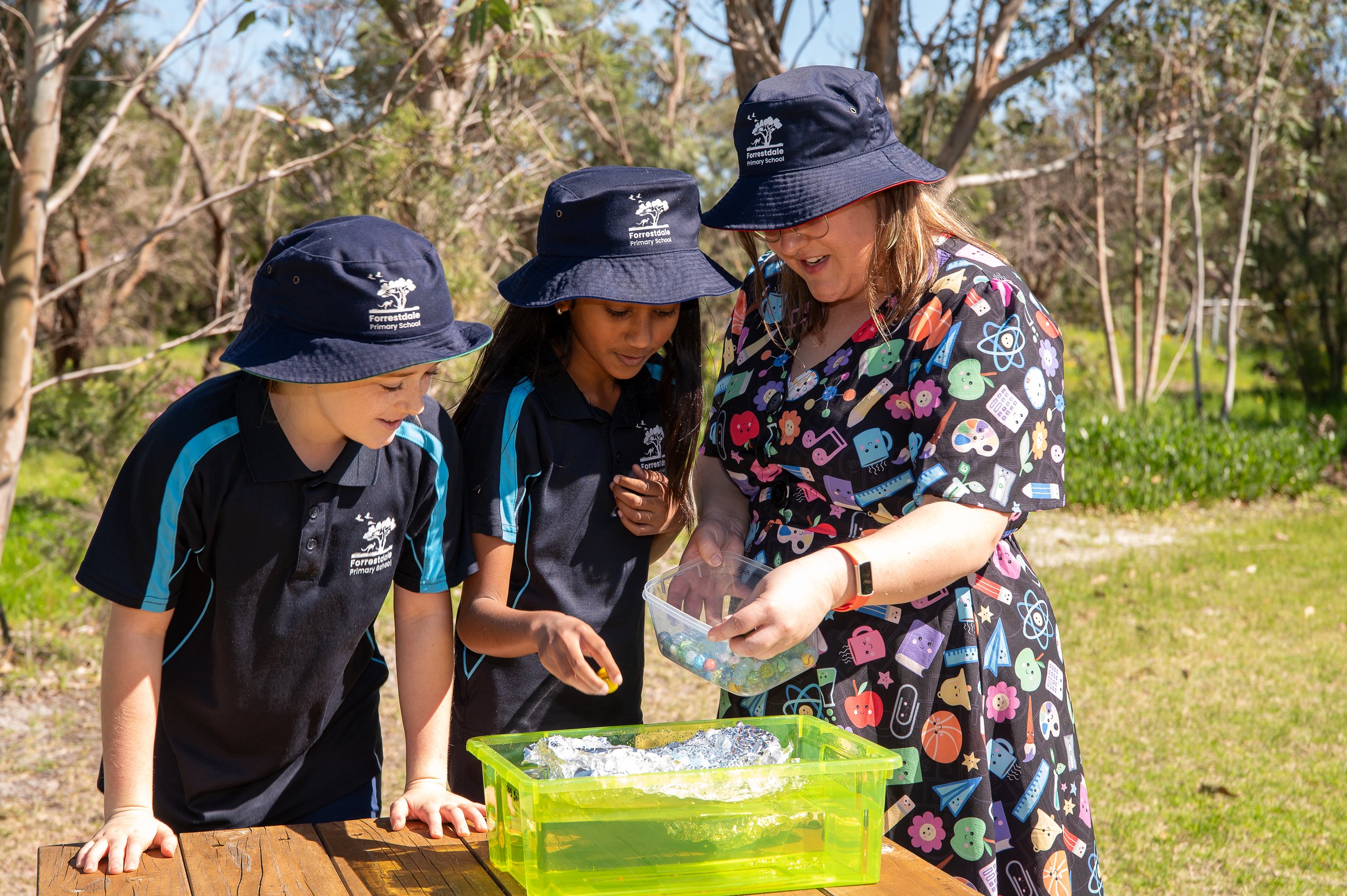
Forrestdale Primary School places a great importance on Science education, which is taught as a specialist subject from Pre-Primary to Year Six. Through the Science curriculum, students are offered opportunities to explore and gain a deeper understanding of the world around them.
The curriculum encourages students to think critically and creatively, and to express their knowledge and understanding in a variety of ways. Each term, the school focuses on planning, teaching, and assessment in different areas of the Western Australian Curriculum, specifically in the strands of Biological Science, Chemical Science, Earth and Space Science, and Physical Science.
By engaging with the Australian Curriculum, students develop scientific knowledge, understanding, and skills that enable them to make informed decisions about local, national, and global issues, and to pursue careers in science-related fields.

The Arts - Visual Arts/Drama
Forrestdale Primary School is committed to delivering a vibrant and engaging arts education. Our Visual Arts program, taught by a dedicated Art Specialist from Year 1 to Year 6, provides students with rich opportunities to explore creativity, express emotions and communicate ideas through a wide range of artistic mediums.
As we move forward, the school will transition from a Music Specialist to a Drama Specialist, broadening the performing arts experiences available to students. Drama lessons will incorporate elements of music, ensuring students continue to engage with performance in meaningful and enjoyable ways. This integrated approach supports confidence, collaboration and communication skills while maintaining a strong and diverse arts curriculum.
Selected students in Years 5 and 6 also have the opportunity to learn guitar, and our school choir will continue to represent us proudly at assemblies and community events.

Physical Education
The Physical Education Program provides students with the chance to engage in various sports and activities, aimed at improving their physical fitness. Throughout the program, students will be able to:
Exhibit motor and fundamental movement skills, allowing them to perform a variety of physical activities.
Gain an understanding of movement concepts, principles, and tactics as they relate to multiple sports and modified games.
Display responsible personal and social behaviour in physical activity settings.
In addition, our students have the opportunity to participate in running clubs and interschool activities, such as lightning carnivals, athletics, and cricket carnivals.
Languages
Students in Years 3 to 6 have the opportunity to learn about the Indonesian language and culture for one hour per week. Our program aims to develop their understanding and appreciation of other cultures, as well as their ability to communicate with Indonesian speakers in both written and spoken forms. As students progress through each year level, their knowledge of Indonesian is built upon, allowing them to acquire a deeper understanding of the language and culture.

Digital Technologies
Learning tools and technology play a vital role in helping students acquire effective self-directed learning skills. They empower students to recognise their learning needs, locate and utilise online resources, apply the acquired knowledge, and evaluate the results. Forrestdale students have access to iPads in classrooms and computers in the library. They are engaged in coding and STEM projects that involve the use of technology across all subjects in the curriculum.

Loose Parts Play
At Forrestdale Primary School we value creativity.
Using loose parts in the learning environment encourages growth in all areas of development. Loose parts give children the freedom to arrange and rearrange, essentially using the parts to create their own rules and designs, which allows the focus of the experience to be on the process rather than the product.

Early Childhood
Our Early Childhood program provides a diverse range of learning experiences that combine explicit and intentional teaching with play-based learning. Our program aims to foster children's curiosity and encourage them to explore and question the world around them. We strive to develop strong foundations in literacy and numeracy, ensuring that every child receives the best possible start to their educational journey.
Enrichment & Extension
At Forrestdale Primary School, all students are closely monitored and tracked so we understand what progress they are making and what potential they have. Our lesson sequences are designed to meet students where they are at, providing both support and extension based on individual learning needs.
In Mathematics, teachers plan using the Western Australian Curriculum and differentiate learning to cater for a range of abilities. Our approach incorporates Paul Swan investigations and challenges, which are highly effective in extending students' mathematical thinking, reasoning and creativity. The Oxford Mathematics program also supports our planning and provides opportunities for students to work at increasing levels of complexity. Students who excel in Mathematics are challenged through rich problem-solving and mathematical reasoning tasks that require them to explain, justify and apply their thinking.
In English, students are extended through opportunities to deepen and broaden their vocabulary, engage with increasingly complex texts, and develop higher-order comprehension, speaking and writing skills. Teachers differentiate learning experiences to ensure students are appropriately challenged and can continue to progress from their current level of achievement.
While our primary approach is to differentiate and challenge students within the classroom setting, should our monitoring and tracking indicate, we also offer withdrawal extension opportunities on a needs basis. Decisions regarding participation in these programs are made collaboratively between the classroom teacher, student and parents, and are guided by our assessment schedule. This ensures that extension opportunities are responsive to individual student strengths, needs and demonstrated achievement.
Rather than a fixed extension pathway, our approach is flexible and responsive, ensuring students are challenged appropriately as they progress through their learning journey.